A separate Scottish system
Planning permission is usually the first big uncertainty in a Scottish self-build. The central question isn't whether the house will look good, but whether a new home is acceptable on that particular site when assessed against planning policy.
Planning in Scotland operates under the Town and Country Planning (Scotland) Act 1997, National Planning Framework 4 (NPF4, adopted February 2023) and each council's Local Development Plan. Planning reforms in England don't apply here.
NPF4 and the wider development plan are read and applied as a whole: no single policy automatically grants or refuses a proposal.
Planning permission and Building Warrants do different jobs
A new home generally needs both. Planning considers land use, siting, design, neighbours, access and landscape: should a home be built here? The Building Warrant checks compliance with the Scottish building standards: is it safe, accessible and energy efficient? A planning approval doesn't replace a warrant, and work that needs a warrant mustn't start until one is granted.
The central question isn't whether the house will look good, but whether a new home is acceptable on that particular site.
Establish the planning position before detailed design
Start with the site boundary, planning authority, Local Development Plan and planning history. Then test the principle of a house, access, drainage, landscape, flood risk, ecology, heritage and neighbours. On some plots the question is whether a house is acceptable at all; on others the principle is settled and the design response is the challenge.
The issues vary by area. In Stirling and Perthshire, countryside policy is often central. In Edinburgh, garden and infill sites raise privacy, character, trees and access. In the Scottish Borders, village context and rural settlement policy often matter most.
- 1A house on the ridge breaks the skyline and is seen from far away: often hard to support.
- 2Set into the slope, low and long, with existing trees behind: the landform and planting help it sit quietly.
- 3Access follows the contours, which reduces cutting, retaining walls and visual impact.
- Self-build planning in Stirling
- Self-build planning in Perth & Kinross
- Building in Loch Lomond & The Trossachs National Park
- Permitted development rights in Scotland
- Self-build planning in Edinburgh and the Lothians
- Building a home in Dunblane and Bridge of Allan
- Self-build planning in the Scottish Borders
Rural self-build and NPF4 Policy 17
NPF4 Policy 17 supports some new homes in rural areas where they are suitably scaled, sited and designed. The circumstances include allocated sites, reuse of brownfield land or redundant buildings, homes for rural businesses, farm retirement and succession, reinstating a former home, and one-for-one replacement of an existing permanent house. The wording matters: Policy 17 isn't a general right to build in the countryside, and each route has its own criteria.
A replacement-dwelling project. Near Melrose, ED Design designed a contemporary family home to replace a group of dilapidated agricultural cottages. Whether a replacement qualifies under a particular Policy 17 route depends on the status of the existing buildings and the council's assessment; the planning basis for any project is set out in its own decision notice. See the Scottish Borders replacement dwelling.
PPP or a full planning application?
Planning Permission in Principle (PPP) establishes whether a house is acceptable on the site without full design drawings. The detail is approved later through applications for approval of matters specified in conditions (AMSC), each with its own requirements. PPP may help establish whether the principle of development is acceptable, but it doesn't guarantee that a particular design, access arrangement, drainage solution or foundation strategy will be approved or affordable. Under the current rules, development must usually begin within five years of PPP being granted, unless the decision says otherwise; there's no statutory deadline for AMSC applications unless a condition sets one. Always read the decision notice, especially when buying a plot with an existing permission.
A full planning application presents a developed design with plans, elevations, sections, a site layout, a Design Statement and any supporting reports. It suits a clear brief, or a sensitive site where the design itself makes the case. Full permission usually lasts three years.
The process, step by step
- Feasibility. Map the constraints and decide whether a house is plausible.
- Pre-application advice. Most councils offer an advice service, some for a fee. It tells you whether the council is likely to support a house before you spend money on detailed drawings.
- Concept design. Develop siting, massing, access and landscape together.
- Surveys and evidence. Commission the surveys you need in time for seasonal windows.
- Submission. PPP or a full application, then respond carefully to any requests for information.
- Decision. Read every condition and obligation in full.
- Conditions and warrant. Discharge pre-commencement conditions and obtain the Building Warrant before work starts.
- 01Pre-application advice4–8 weeks
- 02PPP or full application2–4 months
- 03DecisionOften with conditions
- 04Discharge conditions4–8 weeks each
What makes a convincing application
A strong application explains why this home belongs on this site. The drawings should show its relationship to the land, neighbours, access, landscape and daylight. Supporting information depends on the site and the authority: surveys, drainage, access, heritage or ecology. Not every house needs the same set of reports.
A Design Statement helps even where it isn't required. It should link decisions about massing, materials, orientation and landscape to the real constraints, rather than rely on generic claims of "high quality".
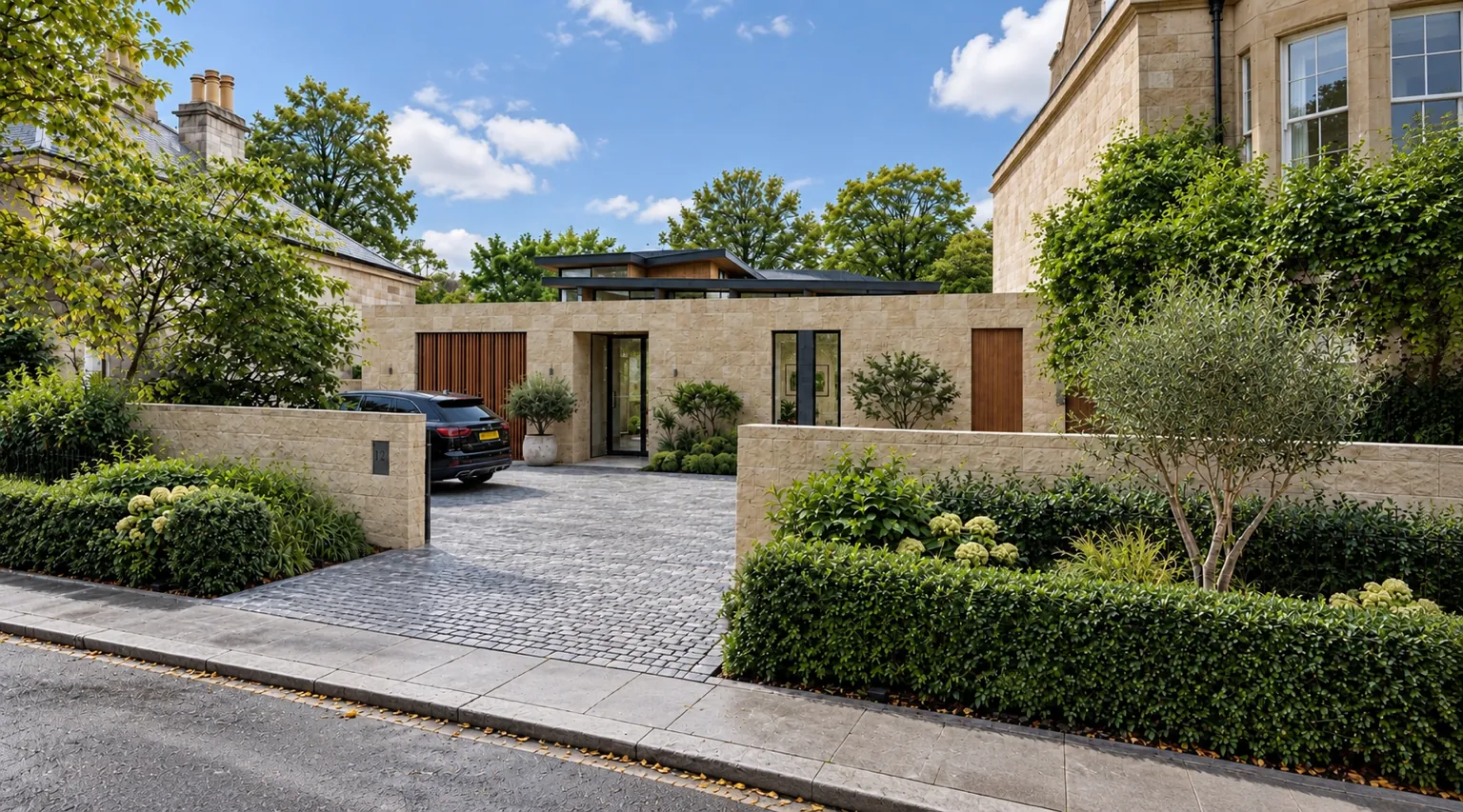
A conservation-area example. At the Grange in Edinburgh, ED Design designed a contemporary family home within the former walled garden of an 18th-century villa in the Grange Conservation Area. The design takes its cue from the original garden walls, so the house reveals very little from the street while opening up to the garden. In historic settings, a reasoned response to context matters more than whether the design is traditional or contemporary. See the Grange project.
Indicative timescales
| Application | Statutory target | Indicative in 2026 |
|---|---|---|
| Pre-application advice | None | 4–8 weeks |
| Planning Permission in Principle | 2 months | 2–4 months |
| Full planning application | 2 months | 2–4 months |
| Approval of matters specified in conditions | 2 months | 6–10 weeks |
| Discharging conditions | Varies | 4–8 weeks per condition |
Taken together, the planning stage of a self-build commonly takes 6–14 months from the first pre-application enquiry. These are indicative assumptions, and statutory targets don't guarantee a determination date. Timescales depend on complexity, consultations and the council's workload, so don't build a finance or construction programme around an assumed decision date.
In Scotland you are legally committed once missives are concluded, with no cooling-off period. Have a plot's planning prospects assessed first.
Common mistakes to avoid
- Buying land because a neighbouring plot was approved.
- Treating PPP as permission to start building.
- Designing the house before understanding levels, access and drainage.
- Assuming a good contemporary design will overcome a fundamental policy conflict.
- Submitting without the evidence needed to assess the site.
- Overlooking conditions, third-party rights or the Building Warrant.
ED Design helps self-builders and homeowners in Stirling, Perthshire, Edinburgh, the Lothians and across Scotland find the right planning and design route for their site. Book a free initial call.
Sources: Scottish Government: National Planning Framework 4; Scottish Government: Planning 2026 update, Ministerial and Chief Planner letter (March 2026); Scottish Government: Planning Circular 3/2022, development management procedures; Scottish Government: Building Standards Procedural Handbook. Last reviewed October 2026.
Questions
How long does planning permission take in Scotland?
The statutory target for many local applications is two months. For early programming, allow around two to four months for a straightforward application, potentially longer for sensitive or complex proposals. The whole planning stage, including pre-application advice and conditions, often runs six to fourteen months.
Do I need planning permission and a Building Warrant?
Yes. A new home in Scotland needs both. Planning permission usually comes first, then the Building Warrant once detailed design is complete.
Can I build in a conservation area?
Potentially, but heritage and townscape considerations will shape what's acceptable and how it's designed. Take site-specific advice.
Can a contemporary house be approved in a historic setting?
Yes, it's considered on its merits. A well-reasoned response to the setting is what counts.
Is PPP the safest route before buying a plot?
It reduces planning uncertainty, but leaves the detail for later. Assess title, access, ground, services and conditions separately.
General guidance for Scotland, not legal, tax, financial or planning advice for your project. Rules change, so check current official guidance and take advice specific to your site before acting.