How much is a planning application in Scotland?
From 1 April 2026, a full planning application for a single new house costs £742. Planning permission in principle (PPP) for one house is also £742, and a householder application to extend or alter an existing house is £371.
Planning fees are set by the Scottish Government in the Town and Country Planning (Fees for Applications) (Scotland) Regulations, so they are the same with every Scottish planning authority. They now rise each April in line with the previous year's inflation: the April 2026 change was an increase of 3.9%, set out in Planning Circular 1/2026.
New house, full application: £742. New house through PPP: £742 for the PPP, then normally £742 for the first approval of matters specified in conditions. Extension: £371. Fees are paid when you apply and are not refunded if the application is refused or withdrawn.
Planning fees for homes from 1 April 2026
| Application | Fee |
|---|---|
| New houses, full application, up to 10 houses | £742 per house |
| New houses, 11 to 49 | £742 for each of the first 10, then £557 per house |
| Planning permission in principle, one house | £742 |
| Planning permission in principle, more than one house (site up to 2.5ha) | £742 per 0.1 hectare |
| Householder: alterations or extension to one house | £371 |
| Householder: outbuildings, walls and fences within the garden | £371 |
| Section 42 application to vary or remove a condition | £371 |
| Certificate of lawfulness, proposed use or development | Half the normal planning fee |
| Listed building consent | No fee |
Larger developments have further bands and maximum fees. Check the current regulations or your council's fee schedule for anything beyond a single house or extension.
What will a self-builder pay?
For most self-builders, the planning fee is one of the smaller costs of the project. The route you take decides how many applications you make:
| Route | Applications | Planning fees |
|---|---|---|
| Full planning application for one house | One application | £742 |
| PPP, then approval of matters specified in conditions | PPP, then one AMSC | £742 + £742 = £1,484 |
| Replacement house on an existing plot | Full application (check whether demolition needs separate consent) | £742 |
| Single-storey extension | Householder application | £371 |
An application for approval of matters specified in conditions (AMSC) is charged at the same rate as a full application. Once the AMSC fees paid under a PPP add up to the fee for a full application, further AMSC applications under the same PPP attract a lower flat fee, £618 from April 2026. So splitting the matters into several applications costs more than one complete submission.
What about a replacement house or a conversion?
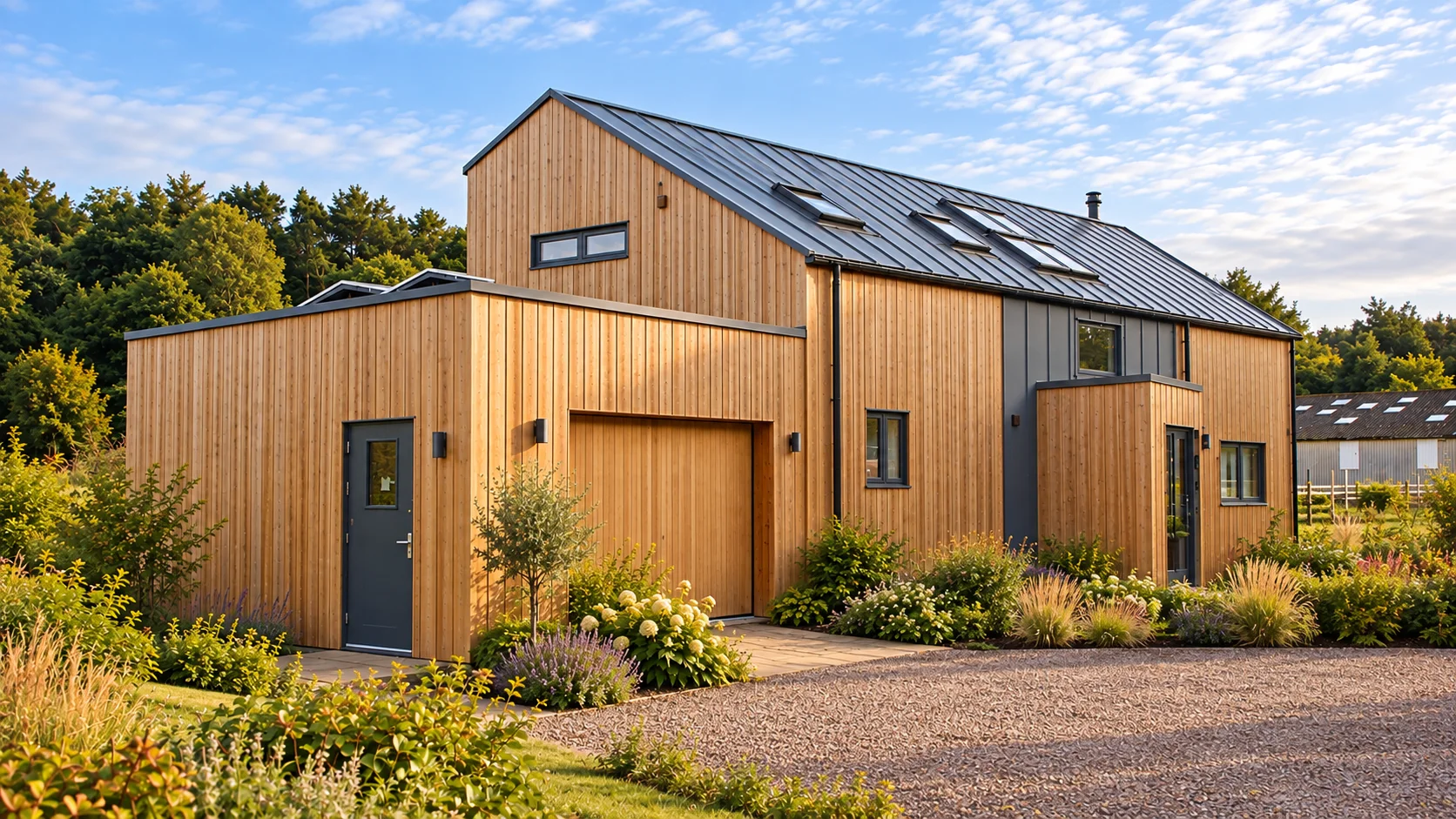
A replacement house is a new house, so it is normally charged at the rate for erecting a dwellinghouse, £742, even though an old house is coming down. Converting a building such as a steading into a home is a change of use, and how it is charged depends on the development and any building work involved, so confirm the category with the council before you submit. In a conservation area, demolition can need separate consent.
Worked example: statutory fees for a rural self-build
For a hypothetical new house in the Stirling countryside, taken through PPP and then AMSC, with £540,000 of building work:
| Fee | Amount |
|---|---|
| Planning permission in principle | £742 |
| Approval of matters specified in conditions | £742 |
| Written confirmation for three conditions, at Stirling's 2023 rate of £100 each | £300 |
| Building Warrant, before any certification discount | £4,374 |
| Total statutory and council fees | £6,158 |
The Building Warrant fee is by far the largest. Council charges such as written confirmation change, so check current figures. See Building Warrant fees for how the warrant fee is worked out.
What other planning charges are there?
Beyond the application fee, councils make other charges, some set nationally and some by the council. Fife and Argyll and Bute's April 2026 schedules give typical figures:
- Non-material variation (a minor change to an approved design): £247 plus VAT in Fife. Argyll and Bute makes no charge if it is requested within 12 months of the decision.
- Written confirmation that conditions have been met: £124 per submission, plus VAT in Fife.
- Retrospective applications: an extra 25% on the normal fee if the work has already been carried out.
- Local review of a refusal by the council's Local Review Body: review fees apply from April 2026, for example £149 for a householder review in Fife.
- Pre-application advice: many councils charge for formal pre-application advice. Check your council's current charges.
Stirling Council introduced its own charges in June 2023: £200 for a non-material variation and £100 for written confirmation or discharge of a condition, with the 25% surcharge on retrospective applications. Check its current figures before you apply.
When is a planning application free?
A repeat application can be free. In general, there is no fee where all of these apply:
- it is made within 12 months of the earlier application being withdrawn, granted or refused, or of an appeal;
- it is for the same site and the same kind of development;
- the earlier application's fee was paid in full; and
- no free repeat has already been used for that site.
The exemption does not apply to planning permission in principle. You must say you are claiming it when you apply. Listed building consent applications have no fee.
Is VAT charged on planning fees?
Statutory application fees, such as the £742 for a new house, are not subject to VAT. Some discretionary council charges are: Fife, for example, adds VAT to its charges for non-material variations and written confirmation of conditions. Check how your council shows its charges.
Buying a plot with planning: who pays what?
If you buy a plot that already has planning permission in principle, the seller will have paid the PPP fee. You pay for the later approval of matters specified in conditions, and for any new application if you want to change the design substantially. If the permission is a full one but you want a different house, a new full application, or a section 42 application where only a condition changes, is usually the route.
When and how do you pay?
The fee is paid when the application is submitted, normally through the national ePlanning portal, and the council will not validate the application until it has the correct fee. It is not refunded if the application is refused or withdrawn. The fee is worked out on the application as submitted, so it does not change if the design is altered later.
How planning fees fit your budget
For a single house, the planning fee is usually much smaller than the reports that support the application, such as tree, ecology, drainage and flood risk assessments, and the design work itself. Budget for all of them in the design and approvals line of your budget, as in our cost guide.
ED Design is an architectural design studio in Stirling. We prepare and submit planning applications for self-build homes, replacement dwellings and extensions, and include the right fee and supporting information first time.
Sources: The Town and Country Planning (Fees for Applications) (Scotland) Amendment Regulations 2026; Scottish Government: Planning Circular 1/2026, planning fees; Planning Circular 2/2025, calculation of fees; Fife Council: scale of planning fees, April 2026; Fife Council: local review fees, April 2026; Argyll and Bute Council: planning fee guidance, April 2026; Stirling Council: new charges for planning applications (2023). Last reviewed November 2026.
Questions
How much is a planning application for a new house in Scotland?
From 1 April 2026, £742 for a full application for one house. Up to 10 houses, the fee is £742 per house.
How much is planning permission in principle for one house?
£742 from April 2026. The later application for approval of matters specified in conditions is normally charged at the full-application rate as well.
How much does planning permission for an extension cost in Scotland?
£371 for a householder application to extend or alter one house, from April 2026.
Do planning fees go up every year?
Yes. They now rise each April in line with the previous year's inflation; the April 2026 increase was 3.9%.
Is the fee refunded if planning is refused?
No. But a repeat application for the same development on the same site within 12 months can be free, except for PPP.
General guidance for Scotland, not legal, tax, financial or planning advice for your project. Rules change, so check current official guidance and take advice specific to your site before acting.