
What is a conservation area?
A conservation area is an area of special architectural or historic interest whose character or appearance the council has a duty to preserve or enhance. The City of Edinburgh Council has 50 of them, and each has a character appraisal describing what makes it special: its layout, building types, materials, gardens, trees and views.
Read the appraisal for your area before you start designing. It tells you, and the planning officer, what the council considers important, and a good design responds to it.
In an Edinburgh conservation area an extension needs planning permission, because householder permitted development rights for extensions don't apply. If the house is listed, it also needs listed building consent. Every extension needs a Building Warrant.
Do I need planning permission for an extension in a conservation area?
Yes. Under Scotland's householder permitted development rights, single-storey and two-storey extensions under Classes 1A and 1B are not permitted development in a conservation area. The council's own quick guide to house extensions confirms that permitted development doesn't apply in a conservation area, and that a Building Warrant is always required for an extension.
The planning application is a householder application, with a fee of £371 from April 2026. The statutory period for a decision is two months. See planning permission and permitted development for extensions.
What other controls apply?
- Listed buildings. Many homes in Edinburgh's conservation areas are also listed. An extension to a listed building needs listed building consent, which has no fee but is assessed separately. See extending a listed building.
- Demolition. Demolishing a building, or a substantial part of one, in a conservation area can need conservation area consent.
- Trees. Trees in conservation areas are protected: you must give the council six weeks' notice before cutting down or lopping most trees, so it can decide whether to make a Tree Preservation Order.
- Other alterations. Some permitted development rights for smaller changes, such as replacing windows or doors, may be restricted. Check with the council before assuming any work is permitted development.
What does the council look for in a design?
The test is whether the extension preserves or enhances the character or appearance of the conservation area. In practice, planning officers look at:
- Position. Extensions to the rear or on secondary elevations, away from street views, are generally easier to justify than anything visible from the street.
- Scale. An extension that is clearly subordinate to the original house, and doesn't overwhelm it or its garden.
- Materials. Either a careful match, such as natural stone and slate, or a clearly contemporary addition in high-quality materials that complements the original.
- Detail. Window proportions, roof edges and the junction with the existing building.
- Gardens and trees. In villa areas especially, the space around buildings is part of the character.
- Neighbours. Privacy, daylight and overshadowing still apply, as anywhere else.
Contemporary design is not ruled out. Historic Environment Scotland's guidance on extensions accepts that a well-designed modern addition can sit more comfortably beside a historic building than a poor copy.
Example: a garden room in a Merchiston conservation area
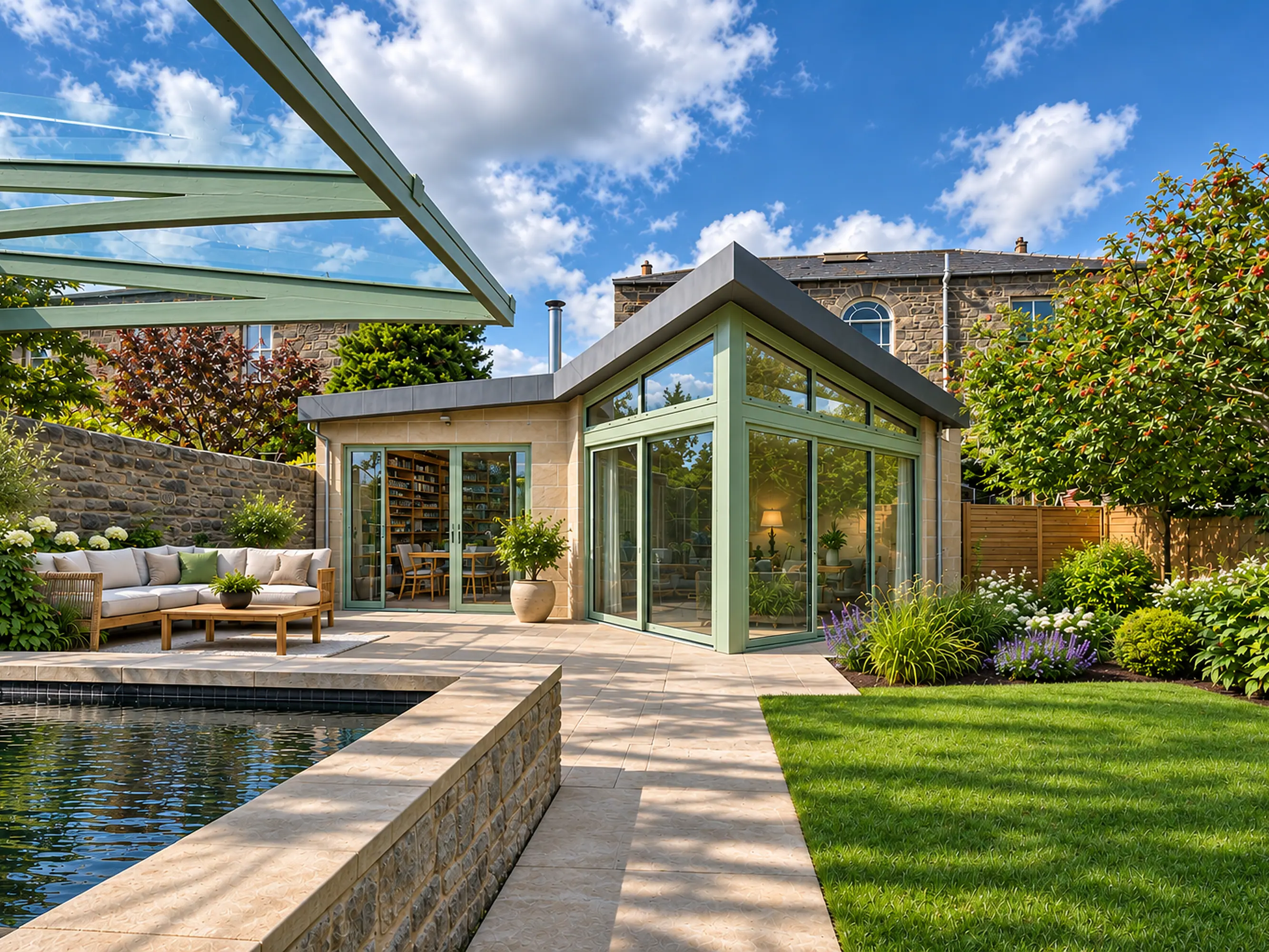
Our Merchiston project is an extension to an unusually split, listed traditional villa in an Edinburgh conservation area. The council restrictions were demanding, and the villa's division and orientation made them harder. The design added a sandstone-clad garden room under a lifted metal roof, a low garage with a car lift that stacks two cars, and a movable glazed cover for the koi pond. A taller garage would have been hard to justify beside a listed villa in a conservation area, so the roof was shaped around the profile of the raised car to keep the building low. The planning application was approved with minimal comment.
How do you apply?
- Check the designations. Confirm on the council's website whether the house is in a conservation area and whether it is listed.
- Read the character appraisal and the council's guidance for householders.
- Survey and design. Start from an accurate survey and test options against the appraisal.
- Consider pre-application advice for anything significant, especially on listed buildings.
- Submit the applications: planning permission, plus listed building consent if needed, with drawings and a short design statement explaining how the extension responds to its setting.
- Discharge conditions. Consents in conservation areas often require samples of materials or details to be approved before work starts.
- Apply for the Building Warrant. See Building Warrants for extensions.
How long does it take?
Allow two months for a straightforward householder decision, and longer where listed building consent, consultation or design changes are involved. Then allow for the Building Warrant and builders' prices. See how long an extension takes.
How we help
ED Design designs extensions in Edinburgh, including in conservation areas and to listed buildings, and prepares the planning, listed building consent and Building Warrant applications. See our work across Edinburgh and the Lothians and our fee guide.
Sources: City of Edinburgh Council: conservation areas; City of Edinburgh Council: quick guide to house extensions; Scottish Government: Circular 1/2024; Planning (Listed Buildings and Conservation Areas) (Scotland) Act 1997, section 64; Town and Country Planning (Scotland) Act 1997, section 172; Historic Scotland: Managing Change in the Historic Environment, Extensions. Last reviewed November 2026.
Questions
Can I build an extension in an Edinburgh conservation area?
Yes, with planning permission. Householder permitted development rights for extensions don't apply in conservation areas, so every extension needs an application.
How many conservation areas does Edinburgh have?
The City of Edinburgh Council has 50 conservation areas, each with a character appraisal.
Can an extension in a conservation area be modern?
Yes. A well-designed contemporary extension in quality materials can be acceptable, provided it preserves or enhances the character of the area and is subordinate to the original house.
Do I need permission to cut down a tree in a conservation area?
You must give the council six weeks' notice before cutting down or lopping most trees in a conservation area.
Is a conservation area the same as a listed building?
No. A conservation area protects the character of an area; listing protects an individual building. A house can be in a conservation area, listed, or both.
General guidance for Scotland, not legal, tax, financial or planning advice for your project. Rules change, so check current official guidance and take advice specific to your site before acting.